
How a Foreigner Can Get a Virtual Card: Requirements and Conditions
#reviews
A passport is almost never the main obstacle to getting a virtual card. Much more often, the problem is a mismatch with the rules of whoever issues it. One service serves only residents of certain countries, another wants to know on what grounds you're staying in your country of residence, and a third only needs you to create an account.
A virtual card has no issuance counter. The card details simply appear on the screen, and from there everything comes down to one thing: whether the issuer, meaning the organization that issues the card, is ready to accept you as a customer.
Let's look at what conditions different issuers set, what to prepare before signing up, and what to compare cards on.
Can a foreigner get a virtual card
Yes, citizenship restrictions are rare. Much more often, a service looks at the country where a person currently lives, so the first thing to do is find the list of countries whose residents it serves in its rules.
Banks issue a virtual card as an add-on to an account. You first have to become a customer and pass all the checks, and only then will the card appear in the app. For someone without a stable status in their country of residence, this is the longest route.
Payment services work differently. They issue a card without a bank account and keep the money on a balance inside the platform. The requirements there are softer, but they have limits too. Many ask for your country of residence and use it to decide whether to serve you. On top of that, the more features a card has, the stricter the verification. A card for large expenses or travel is issued more readily after identity confirmation, while for small online payments, registration is sometimes enough.
For someone who lives outside their country of citizenship and keeps their savings in cryptocurrency, a local bank account changes little. A bank may ask for a residence permit, and platforms still won't accept payment in coins. A payment service card that you top up directly from a crypto wallet is more convenient.
What data you may need
The set of data depends on whether the service requires full identity verification. It's called KYC, from the English "know your customer." Without it, cards are usually issued with small limits, and for extended features you'll have to go through verification.
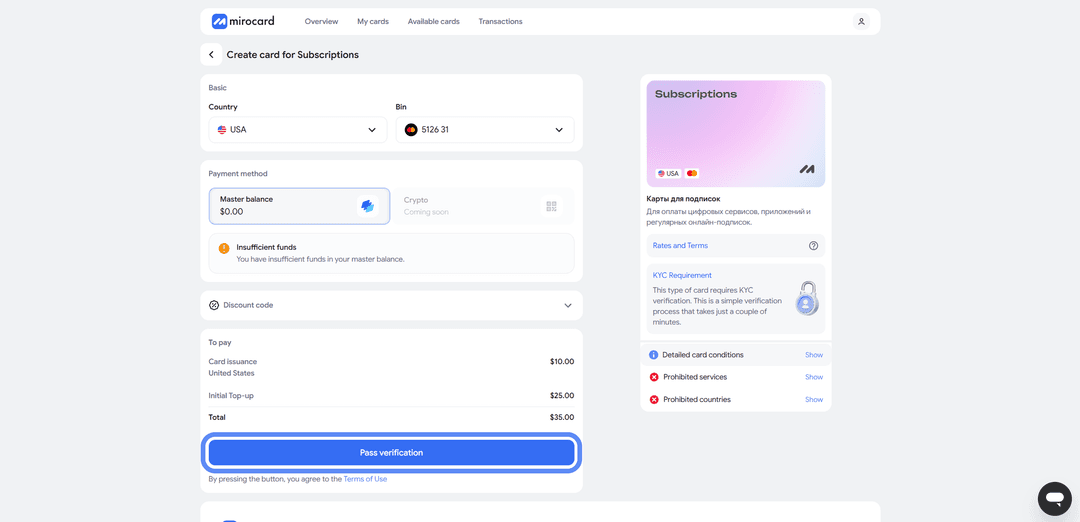
If verification is mandatory, get your passport ready, be prepared to take a selfie, confirm your phone number, and state your country of residence. Sometimes the service asks for additional documents, and the list depends on the country and the card you choose.
For the purchase itself, the card details are enough. Some platforms additionally ask for the cardholder's name in Latin letters and a billing address, so keep these details at hand.
To top up the card with cryptocurrency, you'll need a wallet or an exchange account to send coins from. Check in advance whether the service accepts the coin you need and which network to send it on.
How a foreigner can get a virtual card
The sequence of steps is similar for most payment services. The main peculiarity for a person with a different citizenship is the very first step. First, make sure the service serves residents of your country, otherwise the remaining steps lose their point.
Then decide what you need the card for. Subscriptions need a card that can renew them every month and stays valid for a long time. A one-off purchase only needs an inexpensive issuance. For trips, you'll need smartphone payment. The plan depends on this, as does whether you'll have to go through verification.
Next, create an account and immediately enable two-factor authentication, if available. This is an additional code at login that keeps an outsider out of your account even if they find out your password.
If the plan requires identity verification, complete it before paying. After that, choose a card, pay for issuance, and get the card details. Store them only in your account dashboard and don't send them in messages.
Make your first payment a small one. If it's declined, check not only the balance but also the account region on the platform itself, since some services match it against the card data. Once the payment goes through, turn on notifications and, if you like, set limits.
Cryptocurrency is sent to the card from a wallet or an exchange, and the funds become available after the transfer is confirmed on the network. So top up your balance in advance, before the subscription's billing date.
Mirocard: a virtual card without opening an account at a foreign bank
Mirocard issues virtual Visa and Mastercard cards without opening a bank account. Signing up on the website is free and done online, and you choose the card's payment network yourself.
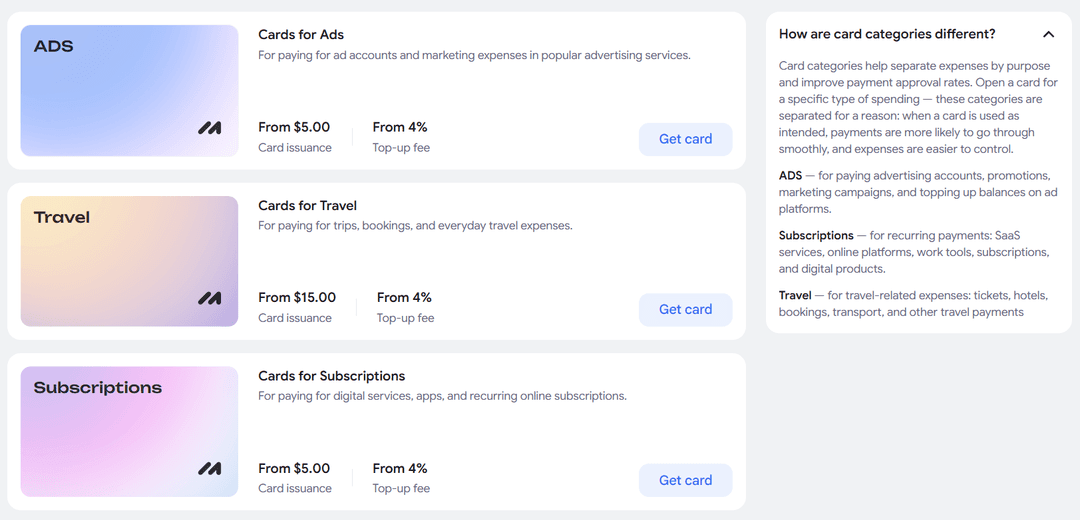
Five dollars is what it costs to issue a Mirocard card for subscriptions and online services. After that, the service takes only 4% of each top-up, and it doesn't charge anything for the card just sitting in your account. You can use it to pay for video, AI tools, games, and cloud storage, and the card is designed for both the first payment and monthly renewals.
For those promoting their business on social media or search engines, a separate advertising card for the same $5 will come in handy. Your promotion spending is then visible separately and doesn't get mixed up with personal expenses.
And those who travel often can get a $15 card that can be linked to Apple Pay and Google Pay, letting you pay for services right from your phone.
We've shown the whole process from signing up to your first purchase in the card issuance guide.
There's no longer any need to withdraw coins through an exchange to a bank account. Mirocard accepts the stablecoins USDT and USDC, as well as BTC, ETH, TON, TRX, and SOL, and you can spend them on platforms that only accept card payments.
Can you use a virtual card outside the country of issuance
Wherever you are, online purchases with such a card work. It was designed from the start for remote payments, and the place of issuance has no connection to the city you're placing an order from.
The payment network is what matters here. Visa and Mastercard are accepted by almost all major platforms. However, some services compare the region of your profile with them against the card data, and if a payment doesn't go through, it's worth opening the profile settings on the platform itself.
Offline is trickier. At a checkout, a digital card will work only if it can be added to Apple Pay or Google Pay. As a rule, you can't withdraw cash with it; for that you need a regular card.
How to choose a virtual card as a foreigner
You should choose based on whether the card suits you personally and your payments, not on the cheapest issuance. Go through a few criteria.
Availability for your country. First, make sure the service works with residents of the country where you live. Otherwise the other conditions don't matter.
Verification requirements. If you don't have the documents the service asks for, choose a plan where identity confirmation isn't required. In return, you'll have to put up with more modest limits.
Subscription support. The service should charge the card every month without your involvement and, if necessary, request a 3D Secure code. Pay attention to how long the card is issued for. A short term means you'll soon have to update the details in every account with a subscription.
Total cost. Add up all the costs at once, from issuance to transaction fees. A card that's nearly free at the start can turn out to be the most expensive if every payment carries a percentage fee.
What happens to the remaining balance. Find out whether you can get back the money left on the card if you no longer need it. This is especially important when the card is issued for a single purchase.
For a crypto holder, it matters which coins and networks the service supports. If the coin you need isn't on the list, you'll have to swap it first, and that's an extra fee.
Conclusion
Citizenship rarely closes the road to a virtual card. Other things do: a country of residence outside the service's list, unfinished verification, or a card that can't do what you need.
When opening a bank account is slow or difficult, a service that issues cards without one comes to the rescue. First check its rules, then gather your data, and only then pay for issuance.